
Are you trying to pick between packing services and DIY for your house move in Lincolnshire?
Wondering whether to book a professional packing service in Lincoln or pack the boxes yourself?
Here is exactly what Barnes of Lincoln’s packing service includes, room by room, plus the real cost of doing it alone.
Ask most people in Lincolnshire why they are packing their own boxes, and the honest answer is nearly always the same: trying to save money.
It looks like a sensible saving right up until moving week arrives, with far fewer spare hours than the plan assumed.
Here we set out exactly what a professional packing service in Lincoln includes, room by room, so you can weigh the real cost of doing it yourself against the real value of paying someone else to do it properly.
A Short Overview of This Blog
Choosing between a packing service and DIY in Lincolnshire comes down to more than the number on a quote. Here is what this guide covers, section by section, so you can jump straight to what matters most to you.
- The Real Cost of DIY Packing: why the free option rarely stays free once time, materials and stress are added up.
- What a Professional Packing Service in Lincoln Actually Includes: the materials, the techniques and the trained crew doing the work.
- Room by Room: How Professional Packers Handle Your Home: from the kitchen cupboards to the loft, and what changes in each space.
- How Long Packing Really Takes: DIY spread across weeks versus a trained crew working to a schedule.
- When DIY Packing Still Makes Sense: honest situations where doing it yourself is a perfectly sound choice.
- Insurance and Liability: Why Packing Method Matters: what happens to a claim if you packed the box yourself.
- Weighing Up the True Cost: a straightforward way to compare what you are really paying, either way.
There is no single right answer here, only the right answer for your move. By the end of this guide, you will know exactly what you are paying for with a professional packing service in Lincoln, and whether it earns its place in your budget.
The Real Cost of DIY Packing
What a Professional Packing Service in Lincoln Actually Includes. Professional
Packing your own boxes feels free because no invoice arrives for it. In reality, it simply moves the cost somewhere less visible, into your evenings, your annual leave and, occasionally, your back.
Start with materials. Sturdy boxes, parcel tape, bubble wrap and packing paper for an average three-bedroom home add up quickly and buying them piecemeal from various shops is rarely cheaper than sourcing them in bulk.
Add the diesel spent driving between suppliers and the true materials bill starts to look a lot like the packing element of a professional quote.
Then there is time. Most people packing a family home alone are looking at multiple evenings and at least one full weekend, often more if life gets in the way, which it usually does.
Every one of those hours is an hour not spent on the hundred other jobs that house moves demand, from meter readings to school transfers.
Finally, there is risk. Moving heavy, awkwardly shaped boxes and furniture without training is one of the more common ways people injure themselves during a house move. Moving is very physical and dangerous if you go at it all gung-ho.
The Health and Safety Executive’s guidance on safe lifting and handling technique is genuinely worth ten minutes of anyone’s time before they start hauling boxes down a staircase, whether that is for work or for their own move.
None of this means DIY packing is a bad decision. It just means the true cost rarely matches the sticker price of a roll of bubble wrap, which is exactly why this comparison matters before you commit either way.
What a Professional Packing Service in Lincoln Actually Includes
This is the part most people are genuinely curious about, and it goes well beyond someone turning up with a stack of boxes.
Barnes of Lincoln’s crews use the same materials available to the public on our packing materials page. These include large and small double-lined cartons, breathable bubble wrap, packing paper, linen bags for soft furnishings, parcel tape, mattress and sofa covers, cotton and paper blankets for furniture, and portable wardrobe boxes that let hanging clothes travel crease-free.
However, the materials are only half the story. What you are really paying for is the method behind them, techniques built up over five generations of family experience and aligned with the standards set by the British Association of Removers, of which Barnes of Lincoln is a proud member.
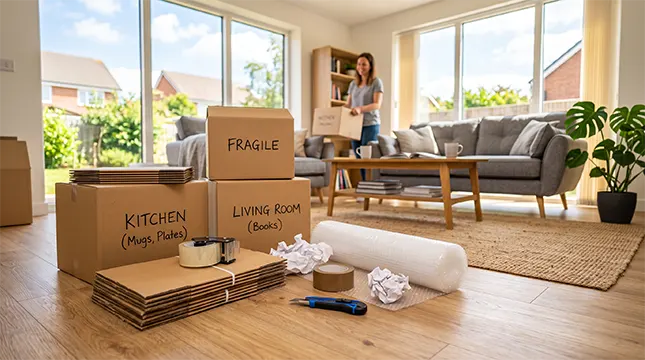
Every box gets weighted correctly so it can actually be lifted safely, fragile items are wrapped individually rather than bundled together, and boxes are labelled clearly by room and contents, then added to an inventory (a copy of which you will keep) so unpacking at the other end is simple rather than a treasure hunt through unmarked cardboard.
You can choose a full pack of the entire home, a partial pack covering specific rooms, or a fragile-only service that leaves the straightforward items, clothes, books and bedding, to you while professionals handle everything breakable.
Room by Room: How Professional Packers Handle Your Home

The value of professional packing becomes clearest once you break a house move down room by room, because each space brings its own quiet challenges.
The Kitchen
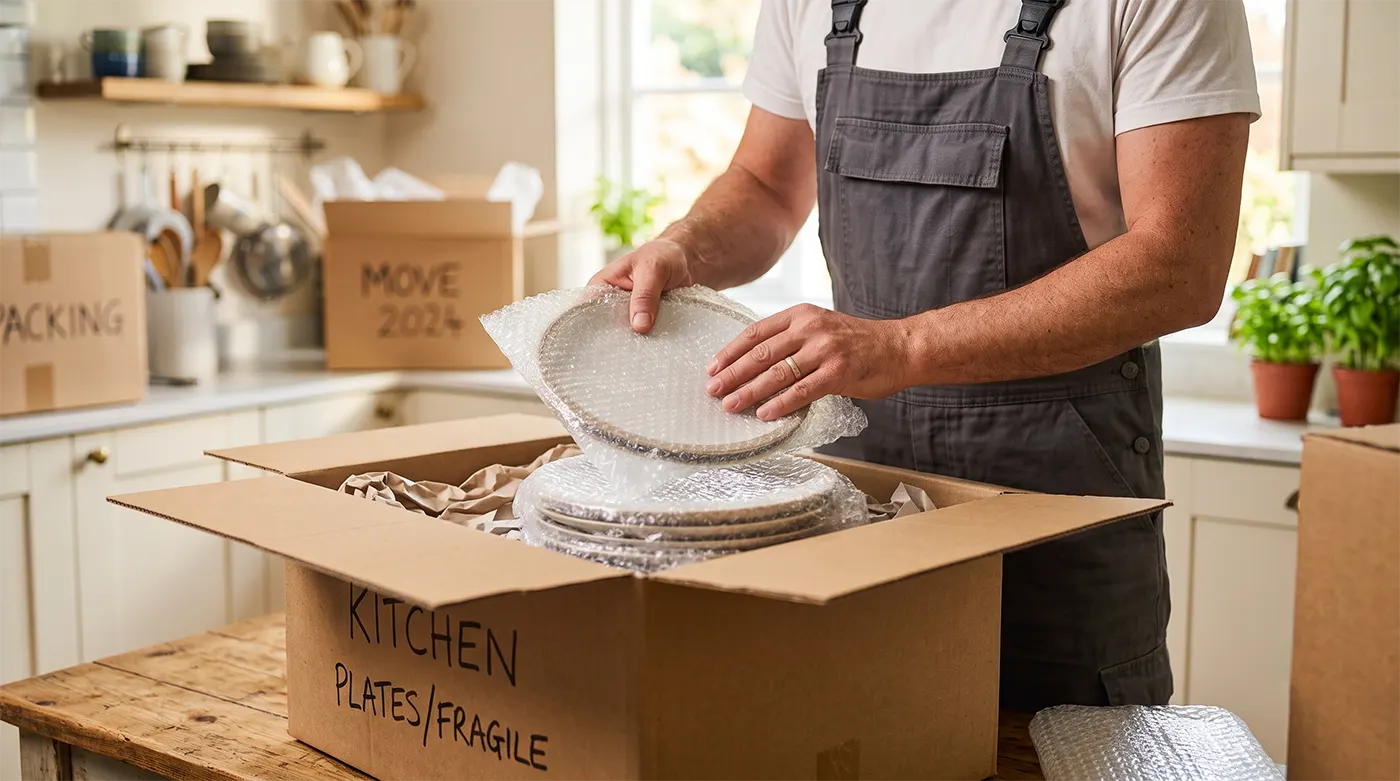
Crockery, glassware and small appliances are the single most likely category of items to be damaged in a DIY move. Professional packers interleave plates with paper, wrap glasses individually, and use double-walled cartons for the heaviest items so boxes do not collapse under their own weight.
The Living Room and Bedrooms
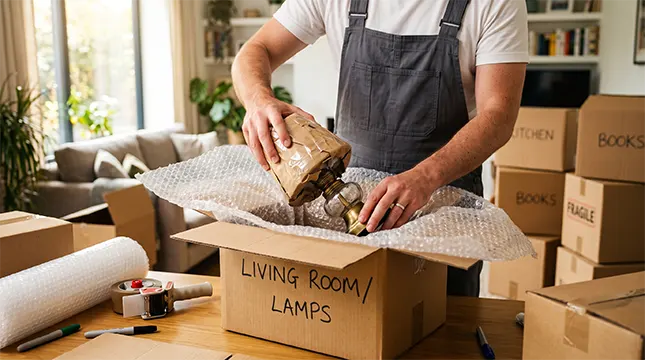
Electronics, artwork, mirrors and ornaments each need slightly different handling. Wardrobe boxes are one of the most appreciated parts of a professional pack, since hanging clothes travel exactly as they left the wardrobe, saving hours of ironing at the other end. Mattresses and sofas get protective covers as standard.
The Loft and Garage
These are usually the last rooms tackled and the first to be forgotten in a DIY pack. They tend to hold awkward, dusty, irregularly shaped items that do not fit standard boxes neatly, which is exactly where trained packers make the biggest visible difference.
It is also a natural moment to declutter before anything is boxed, so nothing you no longer want ends up paid for twice, once to pack and once to move.
If your moving date and your completion date do not quite line up, our secure storage solutions can bridge the gap for anything that needs to sit safely in between.
How Long Packing Really Takes

This is where the comparison often surprises people most.
DIY packing for a typical family home is usually spread across several evenings and at least one weekend, stretched over the weeks leading up to moving day simply because life does not pause for packing. By the time the actual move date arrives, you can feel exhausted before it’s begun.
A trained crew works to a different rhythm entirely, condensing that same job into a single day or two immediately before the move, using Compare My Move’s general guidance on moving timelines as a useful benchmark for how the wider moving week typically unfolds.
For business relocations, the maths is even starker, since every hour spent packing is an hour of lost productivity. Barnes of Lincoln’s office removals service in Lincoln is built around minimising that downtime for Lincolnshire businesses.
When DIY Packing Still Makes Sense

None of this means everyone should rush out and book a full professional pack. There are situations where doing it yourself is entirely sensible.
A small flat or first home with mostly soft, low-value belongings, clothes, bedding and books, is usually straightforward to pack alone with no real risk.
If your moving date is flexible and you genuinely have the spare evenings, DIY can work perfectly well.
A popular middle ground is the hybrid approach. Pack the straightforward, low-risk items yourself using good quality materials from our packing materials page, and bring in professionals purely for the fragile, valuable or awkward pieces where the risk of damage is highest.
It is a sensible way to control costs without gambling on the items that matter most.
Insurance and Liability: Why Packing Method Matters

This is the detail that catches the most people off guard, and it is worth understanding before you decide who packs your boxes.
When items are packed by a professional crew, the removal company has full visibility of how everything was wrapped and prepared, so any damage claim is far more straightforward to resolve.
When you pack your own boxes, removal companies and insurers will decline liability for breakages inside them, simply because nobody but you saw the condition of the contents before they were packed or how they were packed.
We cover this subject in far more depth, including standard liability limits and how MoveProtect works, in our companion guide to removals insurance and what is and is not covered when you move house in Lincolnshire, which is well worth a read alongside this one.
Weighing Up the True Cost
Once materials, time, stress and insurance risk are all added to one side of the ledger, the comparison against a professional packing quote looks quite different to the one most people start with.
A useful way to think about it is this. The DIY route trades a lower upfront cost for a larger hidden one, paid in evenings, petrol, materials and risk. A professional packing service trades a clearer upfront cost for a smaller, better protected hidden one. Neither is wrong, but only one of them tends to come with a genuine surprise attached.
For guidance on what else needs organising around your packing decision, our Moving House Checklist is a handy week-by-week companion from eight weeks out through to moving day itself.
Choose Barnes of Lincoln for Your Lincolnshire Packing Needs

With five generations of experience behind us, Barnes of Lincoln has packed everything from student bedsits to full family homes across Lincoln, Newark and the wider county.
Whether you want a full professional pack, a fragile-only service, or simply high-quality materials to do it yourself, our team can talk you through the right option at your free home survey.
Ready to find out what a professional packing service in Lincoln would cost for your move? Get in touch with our friendly team today for a free, no-obligation quote.
Lincoln, 01522 254 262. Newark, 01636 314 232.
Frequently Asked Questions about Packing Services
How much does a professional packing service in Lincoln cost?
Costs depend on the size of your home and whether you choose a full pack, a partial pack or a fragile-only service. Barnes of Lincoln provides a free, no-obligation home survey so you receive an accurate, tailored quote rather than a generic estimate.
Does a packing service include unpacking at the other end?
Unpacking can be added as an extra alongside your packing service. Speak to our team at your survey stage if you would like boxes unpacked and cleared away once you arrive at your new home.
Do I need to be at home while the packing team works?
It is helpful to be present at the start, so the team understands your priorities and any particularly precious or fragile items, but you do not need to be there for the entire pack. Many customers pop out and come back to find everything neatly boxed and labelled.
Can I book professional packing for just my fragile items?
Yes. A fragile-only service is one of the most popular options, letting you handle the straightforward boxes yourself while professionals take care of glassware, electronics, artwork and anything else that needs extra care.
How far in advance should I book a packing service?
As a general rule, book your removal and packing survey four to six weeks before your move, or eight weeks or more during the busy summer months, to secure your preferred date.
Can I leave clothes in my chest of drawers during a move?
It depends on the weight. Light clothing such as t-shirts or underwear is usually fine left in drawers, as long as the piece of furniture isn’t too heavy to lift safely. Heavier items like jeans, jumpers, or knitwear should be removed and packed separately to keep the unit manageable and prevent damage to the runners.
How long does a typical house removal take?
Local moves within Retford often take between one and two days, although larger properties or complex access arrangements may require additional time.