

Looking for commercial removals in Lincoln and worried about losing work time?
Moving a business is nothing like moving a house. There is no packing up the kettle and living out of a suitcase for a week while things settle. Every hour your office sits half unpacked is an hour your team cannot properly work, your phones cannot properly ring, and your customers cannot properly reach you.
If you are an operations manager or business owner in Lincoln, or anywhere across Lincolnshire, planning a relocation, this guide walks through exactly how a well-run commercial removals project should look, and how to keep your business breathing throughout.
We will cover planning, downtime, IT, packing, and everything in between, all built around one simple goal: moving your office removals without losing a single working day.
A Short Overview of This Blog
Commercial moves live and die on meticulous planning, not luck. Here is a short overview of what this guide covers, so you can jump to the section most relevant to your move.
- Why Commercial Removals Are Different: understanding what sets a business relocation apart from a home move and why it needs a different approach entirely.
- Building a Realistic Timeline: how far in advance to start planning and the milestones that keep a Lincoln office move on track.
- Minimising Downtime: practical scheduling and phasing tactics that let your team keep working while the move happens around them.
- Protecting IT, Servers and Data: how specialist handling and careful planning keep your systems safe and get them back online fast.
- Packing and Asset Management: the labelling, inventory and packing methods that stop a big move turning into chaos.
- Choosing the Right Partner: what to look for in a Lincoln removals company, from accreditation to experience with commercial moves.
- What Happens on Moving Day: a walk through the day itself, from first van arrival to final placement of furniture.
- Settling In After the Move: the practical steps for the first week in your new premises, from signage to notifying suppliers.
- What It Costs: the main factors that influence commercial removals pricing in Lincoln and Lincolnshire.
Read on for the full guide or jump straight to the Frequently Asked Questions at the end for quick answers. Either way, you will finish this article knowing exactly what a smooth office move looks like.

Why Commercial Removals Are Different From a House Move
A house move is disruptive for a few days, and once you are in, it’s up to you how long you take to get settled.
However, a poorly planned office move that takes far too long can cost real money, lost billable hours, missed calls, frustrated clients, and a team that spends its first week in the new building hunting for staplers instead of doing their jobs.
Commercial removals also come with layers a home move simply does not have.
There is IT infrastructure to protect, sensitive client documents that need careful handling, furniture that has to be disassembled and reassembled to a specific office layout, and often a landlord or building manager on each end who needs access arranged around a specific window of time.
At Barnes of Lincoln, we have been moving homes and businesses across Lincoln and Newark since 1919, and the businesses that come through the process most smoothly are almost always the ones who started planning early and treated the move as a project, not an event.

Building a Realistic Timeline for Your Office Move
Give yourself more time than feels necessary; you will thank yourself for doing so.
Commercial moves have a habit of throwing up small surprises: a lease that needs signing off, a landlord who wants two weeks’ notice for lift access, an IT provider who needs three weeks to schedule a server migration. None of this is a problem if you plan for it.
A sensible working timeline for a small to medium Lincoln business looks something like this.
- Eight to twelve weeks before, confirm your new premises, notify your current landlord, and book a free survey with your removals company.
- Six weeks before, start briefing department heads, agree a floor plan for the new space, and flag any specialist items such as servers, safes or archive storage.
- Four weeks before, begin decluttering and archiving, order packing materials, and confirm your moving date and access arrangements at both buildings.
- Two weeks before, finalise labelling systems, brief staff on packing responsibilities, and confirm IT downtime windows with your provider.
- Moving week, pack non-essential items early, keep a go bag of daily essentials, and hold a short team briefing so everyone knows the plan for the day itself.
It is worth remembering to update your registered business address with HMRC once the move is confirmed, along with your bank, insurers, and any suppliers who deliver to your office regularly. It is easy to forget until the post starts arriving at the wrong address.
Minimising Downtime, How to Keep the Business Running
The real skill in a commercial move is not the packing; it is the choreography. The goal is to move enough at once to make progress, without ever stopping the business dead.
A few tactics that consistently work well for our Lincoln clients.
- Move in phases where possible, relocating non-customer-facing teams first so the business keeps functioning from both sites during the transition.
- Schedule the physical move for a weekend or evening, so systems can be reconnected and tested before the team arrives on the first morning.
- Set up a temporary point of contact, a mobile number or forwarded line, so calls are never missed even mid-move.
- Agree a clear cut-off time for placing final orders or scheduling client work in the days either side of the move, so nothing slips through the gap.
- Most importantly, always keep your clients updated; many will put up with the inconvenience if they know what’s happening, while the alternative is unhappy customers who move elsewhere with their business.
If downtime is a particular concern, our office removals service is built around flexible scheduling, including evenings and weekends, specifically to protect your normal working hours.

Protecting IT, Servers and Sensitive Data
For most businesses, IT is the single biggest source of moving day anxiety, and rightly so. Servers are expensive, sensitive, and often the one thing that absolutely cannot be down for long.
A few principles worth following.
- Back up everything before moving day; regardless of how careful the removals team is, this is simply good practice.
- Photograph cabling and connections before disconnecting anything; it saves considerable time on reassembly.
- Use a removals partner experienced in handling servers and sensitive electronics, using appropriate padding, anti-static wrapping and secure transport.
- Plan your IT provider’s schedule around the move, so systems can be tested and confirmed working before staff arrive the next morning.
This is an area where experience really matters.
Our teams are trained by The Movers Institute and regularly handle IT relocations as part of commercial office moves across Lincoln, so equipment is treated with the same care as the rest of your assets.

Packing and Asset Management for a Commercial Move
Nothing slows down a new office quite like a stack of identical unlabelled boxes. A clear labelling and inventory system is the difference between a calm first day and a frustrating one.
- Colour code boxes by department or floor, so removal teams and staff instantly know where each item belongs.
- Number and log everything, particularly IT equipment, filing cabinets and anything containing client records.
- Keep confidential documents together and clearly marked, so they can be prioritised and handled appropriately in line with data protection obligations.
- Use professional packing materials for anything fragile or valuable; cutting corners here tends to cost more in breakages than it saves.
We supply professional packing materials for exactly this purpose, and our team can pack office equipment and furniture for you if you would rather leave it to the professionals.
If your new premises are not quite ready on moving day, our secure storage solutions and document storage give you somewhere safe to hold stock, furniture or files in the meantime, without the move grinding to a halt.
Choosing the Right Commercial Removals Partner in Lincoln
Not every removals company is set up for business relocations, and it is worth asking a few direct questions before you book.
- Do they have experience with office and commercial moves specifically, rather than only home removals?
- Can they offer flexible scheduling around your business hours, including evenings and weekends?
- Do they have the fleet and equipment to handle IT, furniture disassembly, and any specialist items your business relies on?
- What protection is available for your goods in transit, and is this clearly explained before you sign anything?
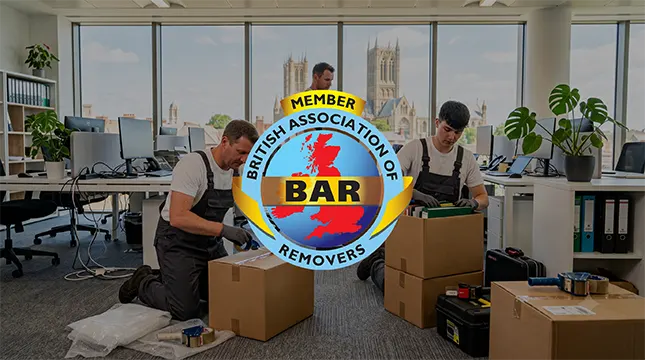
Barnes of Lincoln is a proud member of the British Association of Removers, and our commercial moves follow the same rigorous code of practice as our residential removals.
If you are weighing up local options, the Lincolnshire Chamber of Commerce is also a useful place to check member recommendations from other local businesses who have been through a relocation themselves.
What Actually Happens on Moving Day
Knowing roughly what to expect takes a lot of the stress out of the day itself.
- Your move manager arrives first, confirming access, parking and the plan of action with your team.
- Furniture and equipment are disassembled where needed, wrapped, and loaded systematically, largest and heaviest items first.
- IT and server equipment is handled separately, using specialist padding and, where needed, its own dedicated transport.
- At the new premises, items are placed according to your agreed floor plan, not simply left in the nearest available space.
- A final walkthrough confirms everything has arrived, nothing has been left behind, and any reassembly is complete.
Manual handling is one of the most common causes of workplace injury, which is one reason this part of the job is best left to trained professionals rather than well-meaning staff volunteers.
The Health and Safety Executive publishes useful background on this if you would like to read further.

Settling In After the Move
The move itself is only half the job. A good settling-in period gets your team fully productive within days, not weeks.
- Update your address on your website, email signatures, invoices and Google Business Profile as early as possible.
- Test all IT systems, phone lines and access controls before the first full working day in the new space.
- Walk the new premises with your team, so everyone knows where the fire exits, kitchen and meeting rooms are before day one gets busy.
- Let your clients know that you are up and running as soon as possible.
A short settling-in period built into your plan, even just a half day, gives everyone a chance to unpack properly rather than working around boxes for the first week.
What Commercial Removals Cost in Lincoln
Every business move is completely different, so a fixed figure is almost impossible to provide. What matters more is understanding what drives the price, so you can budget sensibly and compare quotes fairly.
- The volume and type of furniture and equipment being moved, including any specialist items such as servers or safes.
- The distance between premises, and whether any part of the move involves storage in between.
- Whether you need a full packing service or are packing nonspecialist items yourselves.
- Access at both properties, including lifts, stairs, parking restrictions and loading bay availability.
- Timing moves scheduled outside standard business hours can sometimes carry a premium, though the reduction in downtime often makes this worthwhile.
The most reliable way to budget accurately is a free, no obligation survey, where a member of our team assesses exactly what needs to move and provides a clear, itemised quote before you commit to anything.
Ready to Plan Your Commercial Move?
Barnes of Lincoln has been helping businesses across Lincoln, Newark and the wider Lincolnshire region relocate smoothly for over a century.
Whether you are moving down the road or across the county, our commercial removals team plans every move around your working hours, not the other way around.
Get in touch to book your free commercial removals survey, or find out more about our team and our history serving Lincolnshire businesses since 1919.
Frequently Asked Questions About Commercial Removals in Lincoln
How far in advance should we book our office removal?
For most commercial moves in Lincoln, six to eight weeks’ notice gives enough time to plan properly, brief staff and coordinate access at both premises. Larger moves involving significant IT infrastructure or multiple departments benefit from starting closer to twelve weeks out.
Can you move our business without disrupting our working hours?
Yes, this is one of the most common requests we receive. Evening and weekend moves are entirely possible, and phased moves allow parts of the business to keep operating from the old premises while other teams settle into the new one.
Do you have experience moving IT equipment and servers?
Yes, our teams are trained to handle IT equipment, servers and sensitive electronics using specialist packing materials and secure transport, minimising both the physical risk and the downtime involved.
What happens if our new office is not quite ready in time?
We offer secure, flexible storage solutions for exactly this situation, so your furniture, stock or files can be kept safe until your new premises are ready to receive them.
Are our belongings insured during a commercial move?
Standard liability is included as part of your removals contract, and enhanced protection options are also available for higher value equipment or stock. Our team will talk through the right level of cover for your business during your free survey, and you can read more about how removals cover works in our removals insurance guide.
Do you cover moves outside of Lincoln?
Yes, we provide commercial removals across Lincoln, Newark and the wider Lincolnshire area, as well as national and European moves for businesses relocating further afield.